Tuesday, August 10, 2010

What to Do With Your Share---Week 14

Fatigue is setting in out here at the farm. It's all part of summer though, as we can't coast home just yet. But the bounty has fed us well. The diversity of the farm has shone this year, as a disappointing crop of early tomatoes is replaced by wonderful melons.

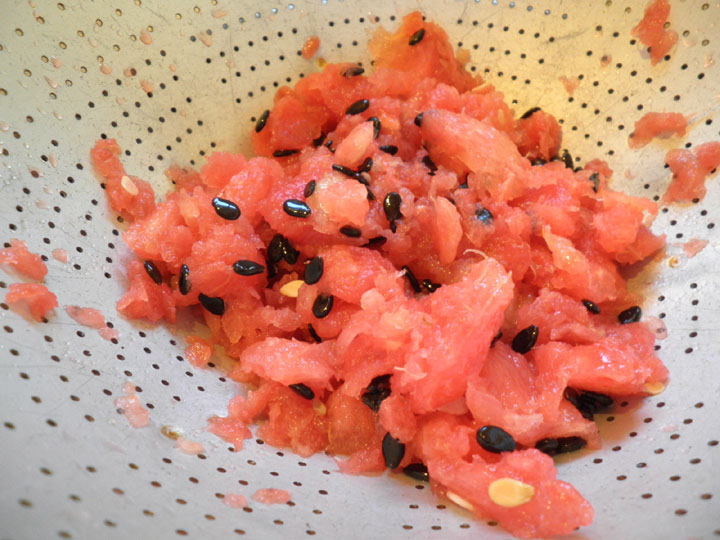
And the thing about melons is that you don't have to cook them. This week's watermelon can be sliced and eaten, or turned into a refreshing juice. Just scoop out the flesh, squeeze it and press it through a colander, and you have a ruby red drink.


We mixed it with some strawberry juice frozen since June, added a little honey, and filled some popsicle containers. Looking forward to one at lunch tomorrow.


It also makes a dynamite drink. Some strawberry/watermelon juice, ice, water, Italian fizzies, a shot of rum and a lime garnish is the cat's meow.

Bulk List---Week 14

We have a lot of tomatillos available this week.

Bulk List
Drying tomatoes: $4.00/qt
Tomatillos: $2.00/lb
Salsa Packs: $2.50/pack
Basil bunch (large pesto size): $4/bunch

In the Share - Week 14

TOMATOES (F/P) Another week of an adequate tomato crop, nothing too overwhelming. Plants that survived the cold, wet early May are doing horrid compared to those planted afterward, some of which are slow to ripen.
WATERMELON (F/P) A choice of two varieties: the red Sangria (oblong and grassy-green on the outside) or the yellow Peace (more round and a lighter green with dark green stripes). As our favorite Coop seed company, Fedco, says "Give Peace a chance".
SALSA PACK (F/P) All full shares get them, partial shares get a choice with carrots
CARROTS All orange this week
GARLIC (F/P) An artichoke softneck variety
HERB CHOICE: Basil, garlic chives or a dried herb. Partial shares choose between garlic and herbs.
SUMMER SQUASH (F) Running out of summer squash recipes? The last planting of the season is just coming on now. Check out FSF CSA member Emily Akin's blog for a recipe for vegetarian squash burgers
CHERRY TOMATOES OR RATTLESNAKE BEANS (F) The pole beans are beginning to slow, so enjoy them while you can
HOT PEPPERS OR EGGPLANT (P) Check Tom's blog from last week for the hot pepper i.d.
EGGPLANT, SWEET PEPPERS OR OKRA (F) Nothing loves the heat more than the okra.

ALSO THIS WEEK: Parker Farms shares delivery

NEXT WEEK: More tomatoes, squash, peppers, eggplant and salsa. A few more melons. The last planting of cucumbers may be starting. Potatoes and onions return.

When Tom and I first moved back to the Graff-Cave Family Farm in the fall of 2002 the region was in the second year of a two-year drought. Photographs from the time contain lots of burned-up grass and stunted crops. Our first irrigation system was built in a hurry out of resources on hand. The old cattle pond served as water source and a gas-powered generator pumped the water to our thirsty crops. It wasn't a very elegant solution, but it kept our plants alive along with our dream of building a truly sustainable farm.
Fast forward to 2010 during a hot, dry summer. Yes, I said dry. Most everyone in the region is feeling the heat this summer, but most have had record rainfall to go with it. Not us. We count ourselves lucky to have missed the 2-5 inch deluges that others have received. The headline of the KC STAR today reads First rain, now heat causes grumbling among growers. While our neighbors to the north and south have much to grumble about, we have been spared for the most part (what's my excuse then?!).


pond full of water makes farmer sleep easy


Dry weather can only be looked upon as good luck if you have an dependable irrigation system. Ours has come along way since our first year at the farm. A new pond and a solar-powered pump bring water to our fields cleanly, quietly and cheaply with a rate of at least 25 gallons per minute. We've been pumping thousands of those gallons on our fields for the better of three weeks now and will probably be pumping for a couple weeks more. As long as we get the usual soaking fall rains, the pond should recharge quickly. Irrigation is especially critical for establishing the fall crops.

Newly transplanted cabbage with drip tape

The next chapter in the irrigation saga is about to unfold. Energize Missouri Agriculture, a program funded with Federal stimulus dollars is helping us expand our solar-powered system. With cost-share funds we were able to purchase additional solar panels and underground supply pipe that will make our system more energy-efficient with better pressure so that we can bring water to the highest sections of the farm. We will be installing the supply line in the next month or two, as soon as the weather breaks and we have time to get to it.


pile of pipe and valve boxes waiting to be put to use


Tuesday, August 3, 2010

The Fair Share Farm Art Project


And now for some CSA fun. The Fair Share Farm Art Project is online. The time has come for all you members and friends of the farm to let us know what you think about food. Express your thoughts in the way that only art can capture.

We have set the stage. The idea, the website, the team, the judges, the opening venue. All that we need now is the art. Go to http://www.fairsharefarmart.com/ to learn the details. The submissions are coming in, so check back often.


All made possible through the generous work of the following:
Stacey Cook, Director---it's only the beginning, eh?
Bobby and Christina Hubbard, web design---awsome job folks
Heather Murphy---inspiring logo Heather
Farmer Rebecca---the stabilizing force

A thanks also to our competition judges: Laura Berman, Dean Kube, Pete Dulin and Pam Taylor. More on them at the Judges link soon. Suffice it to say, the local art community is pumped to help out with the project.

You've know about this since March, but time is running down with only about 8 weeks until the submission deadline. The peak of summer is a great time to reflect on food. Can't wait to hear from everyone.

Bulk List---Week 13

Get your dehydraters working. We have Principe Borghese drying tomatoes available for sale. These small tomatoes are made to be split open and dried. A great raw food. You can eat them like candy, or rehyrate them for your favorite recipe.

We also have an abundance of tomatillos if you would like to buy them by the pound, instead of purchasing a salsa pack.

Bulk List
Drying tomatoes: $4.00/qt
Tomatillos: $2.00/lb
Salsa Packs: $2.50/pack
Jalapenos: $2.50/pint
Pepperoncinis: $4.00/quart
Basil bunch (large pesto size): $4/bunch
Summer squash/cucumbers-lg $1.25 ea
Summer sq/cucumbers-med $0.75 ea
Summer sq-small $3.25/qt

In the Share - Week 13

TOMATOES (F/P) The heat is ripening them fast right now and the dry weather is concentrating their flavor.
POTATOES (F/P) Mainly Kennebec but we'll be filling in with some Desiree. The links take you to our supplier of potato seed.
WALLA WALLA ONIONS (F/P) Not many more sweeties, but we think enough for everyone this week.
SALSA PACK (F) Last year's survey prompted us to grow more salsa fixins and they just keep on coming.
HOT PEPPERS OR EGGPLANT (F) See Tom's post for more info on the different types of hot peppers that we grow.
CUCUMBERS AND SWEET PEPPERS (F) One of each
SUMMER SQUASH (F) More sweet little pattypans
RATTLESNAKE POLE BEANS (F/P) Our favorite beans, so tender and with real bean flavor.
CANTALOUPE (P) Keep these out of your fridge until completely ripe and sweet. The cantaloupe go to the partial shares in KC this week, since they didn't receive any last week. Partial shares on Saturday will get salsa packs instead.
HERB CHOICE (F/P) Basil, Summer savory, Garlic chives or a dried herb.

ALSO THIS WEEK: Bread of Life Bakery shares

NEXT WEEK: More tomatoes, summer squash, beans, eggplant, peppers and salsa. Perhaps the first watermelons. More carrots and garlic.

We know what you are all wondering. Yes, it is hot even for us seasoned, acclimated-to-the-outdoors farmers. The good news is the crops so far seem to be taking it in stride more than the humans who are tending them. It helps that we have a big pond of irrigation water and that most of our summer crops have either a thick layer of mulch or have a vining habit that creates it's own shade. Our biggest challenge is caring for the newly-planted fall crops. Yesterday I cultivated our baby fall cauliflower, brussel sprouts and broccoli with our electric Allis Chalmers G.

While the tractor gets alot of the weeds, we still need to come through with hoes for the weeds in row and any others that survived. That took the rest of the afternoon, but by the end they were weed-free and getting a good dose of water.
Harvesting takes up the majority of our time at the moment. It is a pretty enjoyable task, especially when the crop is good. And when you have a great crew to help.


Here are the Saturday bean pickers after a hot slog through 400 ft. of pole beans ... and still smiling.
Harvesting requires close inspection of each plant and often leads to discoveries beyond the crop itself. As with this perfect little bird nest amongst the drying tomatoes.
(yes, we grow tomatoes suited for dehydrating. Check the bulk list for more info.)


Harvesting also rewards us with big dose of all natural color therapy. Working our way through the squash patch we are cheered by their many sunny flowers.


And there's one of "our" honeybees working to feed her community and also increasing our crops in the process. Thank you honeybees!


What to Do With Your Share---Week 13

Hot Peppers
They say when life gives you lemons, make lemonade. This week we say, when life is stifling hot, give the members hot peppers.

Our crop of these spicy solanaceous plants is doing better this year than any other. We have more than we need right now for salsa packs, pickling and the swap box, and so we are making them a choice for the shares.

We only grow a limited amount, as they are something that we know not everyone cares for. But we hope that you are daring enough add them to your favorite dish, or otherwise enjoy their spiciness. There are 4 types to choose from this week.


Left to right:
NuMex Joe E. Parker (Anaheim type)--This variety is the mildest of the four. We like it raw in salads as an alternative to green sweet peppers. It is best though, when roasted and peeled. Cut off the top/stem, slice in half, remove the seeds, and place skin side up on a baking sheet. Roast at 450 deg F or broil for about 10 minutes, until charred. Place in a glass bowl and cover with a plate. This helps to steam off the skins. Then, when cool to touch (10 to 20 minutes), simply peel the skin off and you have a flavorful, tangy pepper.

Volcano (Hungarian wax pepper)--These plants are from some free seeds we got last year. The plants produce well and the peppers are nice and hot, but with a fire that doesn't last in your mouth too long. They turn orange and then red when mature. These are good raw added to your favorite salad, or grilled with your favorite veggies.

El Jefe (Jalapeno)--Quite hot. Just one in your salsa pack can provide just the right amount of spiciness. Two will make it firey hot. There are hundreds of ways to enjoy jalapenos; fresh, pickled, roasted, smoked, deep fried, jellied...the list goes on. Use the power of the web to explore the possibilities.

Use caution when handling these peppers, as they can make your fingers burn. And be sure not to rub your eyes or other extremities after handlings them.

Italian and Greek pepperoncini--You may be familiar with these as some pizza parlors garnish their dishes with them. Moderatley hot, they are traditionally pickled, but we also like to eat them raw. A simple recipe is to chop up one medium tomato, one medium cucumber, half a sweet onion, and about 3 to 4 pepperoncinis and dress this salad with balsamic vinegarette or some other Italian dressing.