We have a bulk list this year before the season even starts! For those newbies out there, each week we post a list of those vegetables we have extra of and sell to the membership. If you would like to purchase items simply email me (Tom) at my farm email of tom(@)fairsharefarm.com. Your order and a bill will be sent into distribution. You can pay the distribution coordinator and they will see that we recieve your payment.
Leeks---$3.50/lb
Lettuce---$3.50/hd
Green garlic---$3.00/bunch
Cilantro, dill, fennel, garlic chives or mint---$3.00/bunch
Thursday, May 12, 2011

Getting Ready for Next Week
The weather, the day length and the crops all say it is time to start the Fair Share Farm CSA season next week. For the past several weeks we have been sampling the fare and eating well here at the farm. Now it is time to start getting those fresh veggies to you.
Rebecca's recent email includes the details you need to know for picking up your vegetables and planning for your work days at the farm. We look forward to serving up a nice share next week.
In preparation, we have been uncovering many of the crops that were shrouded in row cover during the early Spring. The lettuce and broccoli are now out in the open air. Lettuce is doing great---beautiful multi-colored heads of leaf, butterhead and romaines still growing. The broccoli looks good too, though we have hade some loss due to voles and crown rot.


Over the last week we have had a lot of help from the Spring 2011 William Jewell College Ecology of Food class. Their professor and friend, Paul Klawinski, requires that the students put in service learning hours as a part of this exceptional class. On Monday a crew of 5 helped us wash and sanitize all of our crates. On Tuesday they helped us harvest, trim and clean 400 row feet of leeks. Thanks to all.

Monday also heralded what might be known as leek week here. Each year we plant leeks for harvest the following Spring. This year's crop, started in the greenhouse in February 2010, braved last years wet Spring and Summer, as well as a very cold winter with little dieback. As it starts its second year of growth it wants to flower, requiring that we harvest the leeks now instead of next week. You can expect a generous size share of this elegant and flavorful vegetable next week.

Leek week continued with the planting of this year's Fall crop. Over 1,600 leek transplants were trimmed and planted in a matter of hours thanks to our electric tractor and our transplanter. They will be ready in October and for the annual Thanksgiving shares. Next year's Spring leeks are still in the greenhouse and will go out soon.

Leek transplants

Rebecca's recent email includes the details you need to know for picking up your vegetables and planning for your work days at the farm. We look forward to serving up a nice share next week.
In preparation, we have been uncovering many of the crops that were shrouded in row cover during the early Spring. The lettuce and broccoli are now out in the open air. Lettuce is doing great---beautiful multi-colored heads of leaf, butterhead and romaines still growing. The broccoli looks good too, though we have hade some loss due to voles and crown rot.


Over the last week we have had a lot of help from the Spring 2011 William Jewell College Ecology of Food class. Their professor and friend, Paul Klawinski, requires that the students put in service learning hours as a part of this exceptional class. On Monday a crew of 5 helped us wash and sanitize all of our crates. On Tuesday they helped us harvest, trim and clean 400 row feet of leeks. Thanks to all.

Monday also heralded what might be known as leek week here. Each year we plant leeks for harvest the following Spring. This year's crop, started in the greenhouse in February 2010, braved last years wet Spring and Summer, as well as a very cold winter with little dieback. As it starts its second year of growth it wants to flower, requiring that we harvest the leeks now instead of next week. You can expect a generous size share of this elegant and flavorful vegetable next week.

Leek week continued with the planting of this year's Fall crop. Over 1,600 leek transplants were trimmed and planted in a matter of hours thanks to our electric tractor and our transplanter. They will be ready in October and for the annual Thanksgiving shares. Next year's Spring leeks are still in the greenhouse and will go out soon.

Leek transplants

Planted leeks
Thursday, May 5, 2011
The Beginnings of Summer
As farmers, we try to spend a lot of our time listening. Listening to the plants, the soil, the weather forecast, to better manage the farm. Since 2008, arguably our wettest and toughest year, we have modified our growing practices to alleviate the distress caused by too much rain.
From taking some areas out of production, to guttering our beds with our electric tractor, to using more mulch, these changes paid off in the likewise wet years of 2009 and 2010.
Last year we learned what we should have already known about planting summer crops like tomatoes---wait until it is warm. In 2010 late April and early May saw cold, wet days and nights that killed the feeder roots of three beds (about 300 plants) worth of plants and lead to a harvest at less than 50% of what we should expect.
This year we have been more patient, waiting for what looks like the beginning of day and night temps over 50 degrees. Tomatoes are heat loving plants, and plants that are warm and happy for their whole life grow just as fast, if not faster, than ones put out in the cold to start.
So Wednesday the farm crew set out 100 cherry tomato plants and 100 hybrid determinate plants. Yet to come are 100 hybrid determinates, 300 heirloom, and 200 paste tomatoes. We finish off our tomato planting in about a month with a final bed of summer (heat tolerant) tomatoes.

Tomato planting
Other goings on include walking by the strawberries every day and marveling at their lush green growth and many flowers. At the moment things look right for another successful strawberry season. Keep your fingers crossed.


Elsewhere in the field the broccoli and cabbage planted under the warmth of the row cover are growing as well as in any Spring. As they size up they make thier presence more obvious behind the shear fabric. Other crops are growing well too, as can be seen in the photo of this year's garlic crop.


Meanwhile, in the greenhouse, we are finishing up most of our seeding and moving plants from the greenhouse, to the cold frame, to the field. It is interesting to watch the cucurbit seeds germinate in the soil blocks, as their large seeds seem to explode through the soil surface and unfurl thier leaves.

From taking some areas out of production, to guttering our beds with our electric tractor, to using more mulch, these changes paid off in the likewise wet years of 2009 and 2010.
Last year we learned what we should have already known about planting summer crops like tomatoes---wait until it is warm. In 2010 late April and early May saw cold, wet days and nights that killed the feeder roots of three beds (about 300 plants) worth of plants and lead to a harvest at less than 50% of what we should expect.
This year we have been more patient, waiting for what looks like the beginning of day and night temps over 50 degrees. Tomatoes are heat loving plants, and plants that are warm and happy for their whole life grow just as fast, if not faster, than ones put out in the cold to start.
So Wednesday the farm crew set out 100 cherry tomato plants and 100 hybrid determinate plants. Yet to come are 100 hybrid determinates, 300 heirloom, and 200 paste tomatoes. We finish off our tomato planting in about a month with a final bed of summer (heat tolerant) tomatoes.

Tomato planting
Other goings on include walking by the strawberries every day and marveling at their lush green growth and many flowers. At the moment things look right for another successful strawberry season. Keep your fingers crossed.


Elsewhere in the field the broccoli and cabbage planted under the warmth of the row cover are growing as well as in any Spring. As they size up they make thier presence more obvious behind the shear fabric. Other crops are growing well too, as can be seen in the photo of this year's garlic crop.

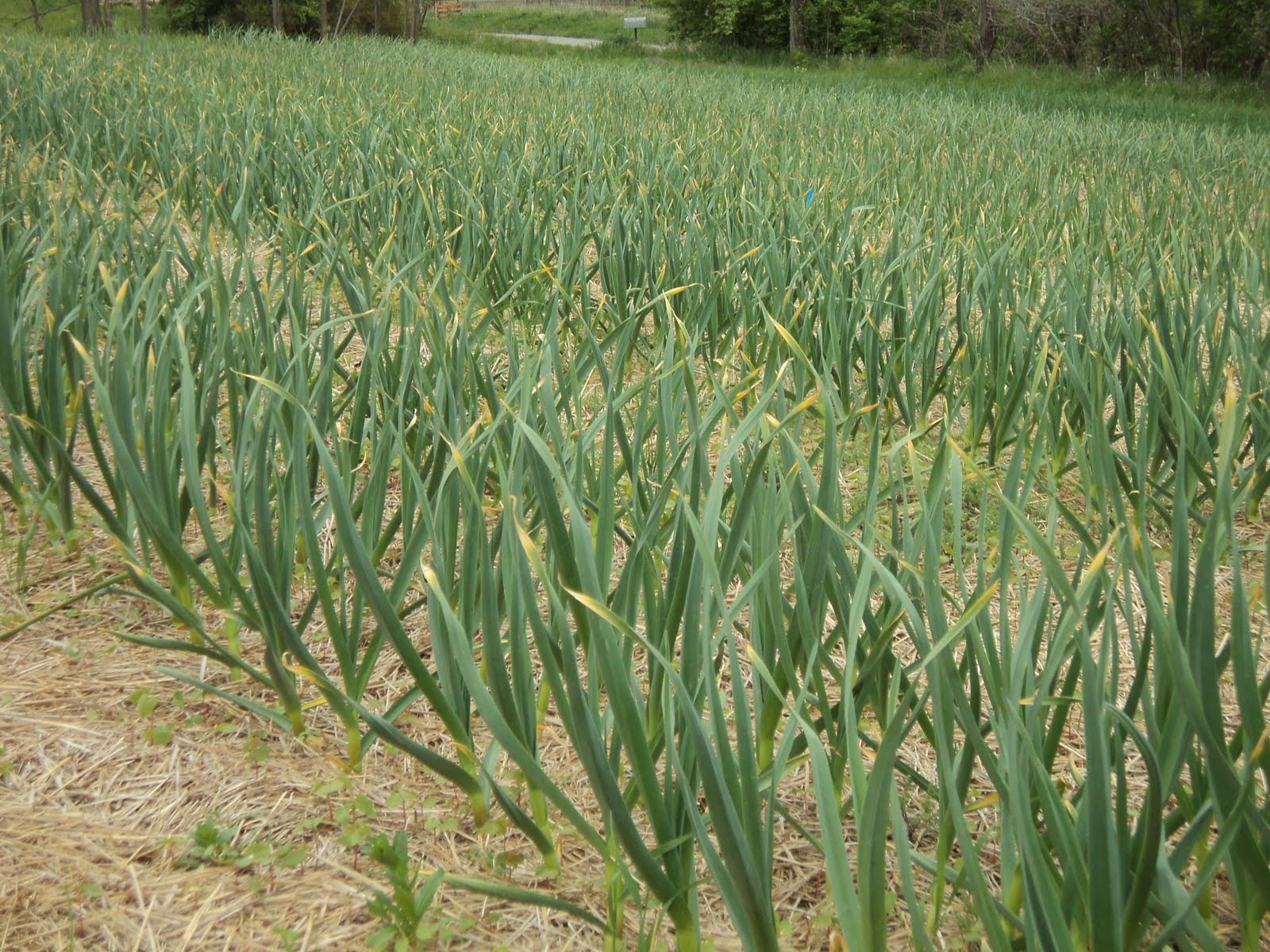
Meanwhile, in the greenhouse, we are finishing up most of our seeding and moving plants from the greenhouse, to the cold frame, to the field. It is interesting to watch the cucurbit seeds germinate in the soil blocks, as their large seeds seem to explode through the soil surface and unfurl thier leaves.

Sunday, April 24, 2011
Thinking of Summer
The Spring has been good so far, though it has gotten a bit wet lately. We have reached the point in planting where we are shifting our focus to the warm weather crops of summer.
Seedlings were started over a month ago, and now the tomato transplants are inching closer to the fields. We put the cherry and cage tomatoes in the cold frame on Friday to give them a good week to "harden off" before planting them near the end of the month.
The peppers and eggplant continue to grow, though we have had to re-seed some due to poor germination. This week we also seeded the first batch of cucumbers and melons in soil blocks, as well as all of the winter squash. As we pull roasted red peppers and eggplant out of our freezer, and canned tomato sauce out of the larder we can taste the expectations of summer. We are out to finish last year's stores so we can make room for the 2011 harvest.

Tomato transplants in the cold frame

Soil block of melons
Work continues on the Spring crops. Thinning of the spinach, turnips, radish, arugula, carrots and beets is in order right now. While somewhat tedious there is always a nature show during the work. Our contact with the ground rumbles the soil and forces the many earthworms in our beds to the surface. They stretch out of their burrows and make their way along the surface before disappearing again to do their work.


Lettuce growing


Rocky keeping watch

Seedlings were started over a month ago, and now the tomato transplants are inching closer to the fields. We put the cherry and cage tomatoes in the cold frame on Friday to give them a good week to "harden off" before planting them near the end of the month.
The peppers and eggplant continue to grow, though we have had to re-seed some due to poor germination. This week we also seeded the first batch of cucumbers and melons in soil blocks, as well as all of the winter squash. As we pull roasted red peppers and eggplant out of our freezer, and canned tomato sauce out of the larder we can taste the expectations of summer. We are out to finish last year's stores so we can make room for the 2011 harvest.

Tomato transplants in the cold frame

Soil block of melons
Work continues on the Spring crops. Thinning of the spinach, turnips, radish, arugula, carrots and beets is in order right now. While somewhat tedious there is always a nature show during the work. Our contact with the ground rumbles the soil and forces the many earthworms in our beds to the surface. They stretch out of their burrows and make their way along the surface before disappearing again to do their work.
Maintenance work and barn cleanup was also on the list last week as we have a long list of rainy day tasks to do.

Rebecca thinning hakurei turnips

Earthworm and turnip seedlings

The view from our window

Lettuce growing

Lucas working on our "new" mower

Rocky keeping watch
We also were able to do some mushroom hunting at the end of the day. We had been hearing many reports that the morels were out, and we have been able to find enough for several meals and snacks. The tree ear mushrooms are also fruiting.

Thursday, April 14, 2011
Flame Weeding and Cover Cropping
As the nice weather continues, our work continues to pick up. From potting up tomatoes in the greenhouse, to planting and mulching more broccoli, to equipment maintenance. The order of the day yesterday though was cover cropping.
We have experienced the many benefits of cover cropping over the past several years and have worked up a system that seems to work well for our farm. Each spring we spread a mix of chickling vetch and oats on the beds that will be planted with our fall crops. The beds are cultivated to eliminate (most all) weeds, the seed is broadcast, the tractor harrows them in, we wait for rain to help them germinate, and then watch them grow into a mass of green organic matter.
Sometime in late June we will spade this "green manure" in and let it decompose for a couple weeks. Soon after we cultivate to get any small weeds that want to come up, and then plant our fall crops. The feel and smell of the soil at this point is just something you have to experience. It is alive and fully cycling nutrients, creating the conditions we organic farmers work for.
The video and photo speak for themselves. What isn't shown is the taste treats we enjoyed as a part of this exercise. The asparagus has already come up and, while we harvested what we saw, when we started burning we could see there were still spears coming out of the ground.
Well the fire served to do nothing more than char those spears, allowing us to harvest grilled asparagus! That's why we love this job.
We have experienced the many benefits of cover cropping over the past several years and have worked up a system that seems to work well for our farm. Each spring we spread a mix of chickling vetch and oats on the beds that will be planted with our fall crops. The beds are cultivated to eliminate (most all) weeds, the seed is broadcast, the tractor harrows them in, we wait for rain to help them germinate, and then watch them grow into a mass of green organic matter.
Sometime in late June we will spade this "green manure" in and let it decompose for a couple weeks. Soon after we cultivate to get any small weeds that want to come up, and then plant our fall crops. The feel and smell of the soil at this point is just something you have to experience. It is alive and fully cycling nutrients, creating the conditions we organic farmers work for.
Below is a video of Lucas broadcasting the seed. A clearer version is on YouTube.

The seed after broadcast

Getting ready to harrow
The fun really began though when, for the first time in farm history we put our flame weeder to work. After buying a new part this week, we got the bugger working, taking on a project we had planned on tackling for many years, the asparagus beds.
In our last post we talked about the problems with these beds and our plans to abandon them when the new patch kicks in. But in the meantime we hope to harvest some quantity of asparagus from the old bed.
The video and photo speak for themselves. What isn't shown is the taste treats we enjoyed as a part of this exercise. The asparagus has already come up and, while we harvested what we saw, when we started burning we could see there were still spears coming out of the ground.
Well the fire served to do nothing more than char those spears, allowing us to harvest grilled asparagus! That's why we love this job.

Thursday, April 7, 2011
April Planting
We entered April with some beautiful weather and put it to good use. In what may be a Fair Share Farm record, on Tuesday we planted 1,200 row feet of broccoli, 600 ft of cabbage, 300 ft of lettuce, 1,200 ft of potatoes, and 600 feet of onions. We were able to do this mainly with the aid of our transplanter. The cover cropping we did on our beds last season, the winter freeze thaw action, and our workhorse electric tractor also played a major role, creating an incredibly loose, friable, weed free soil to plant in.

Lucas cultivating

Rebecca and Lucas transplanting broccoli

Mulching the broccoli and cabbage
At our last Core Group meeting we were asked if we were doing anything new this year. I said no, forgetting that we purchased over 500 asparagus crowns to create a new patch. Our old patch has never been real happy, and last year appeared to be disappearing prematurely. The new patch will be planted putting our 9 years of experience on this piece of land to work.
First we spaded the beds last fall to allow them to loosen up over the winter. Then we limed the beds before cutting trenches to plant the asparagus in. Next step was to help out these alkaline loving plants by spreading wood ash from our stove, before planting the gangly crowns in the bottom of the trench. As the plants grow we will slowly fill in the trench with compost and topsoil before giving the whole patch a layer of hay mulch to hold down the weeds and retain moisture. We are hoping to have a nice bunch of asparagus as a regular item in the first week or two's shares in a couple of years.

Asparagus crowns laid out for planting

Planting the crowns into the trench

Lucas cultivating

Rebecca and Lucas transplanting broccoli

Mulching the broccoli and cabbage
At our last Core Group meeting we were asked if we were doing anything new this year. I said no, forgetting that we purchased over 500 asparagus crowns to create a new patch. Our old patch has never been real happy, and last year appeared to be disappearing prematurely. The new patch will be planted putting our 9 years of experience on this piece of land to work.
First we spaded the beds last fall to allow them to loosen up over the winter. Then we limed the beds before cutting trenches to plant the asparagus in. Next step was to help out these alkaline loving plants by spreading wood ash from our stove, before planting the gangly crowns in the bottom of the trench. As the plants grow we will slowly fill in the trench with compost and topsoil before giving the whole patch a layer of hay mulch to hold down the weeds and retain moisture. We are hoping to have a nice bunch of asparagus as a regular item in the first week or two's shares in a couple of years.

Asparagus crowns laid out for planting

Planting the crowns into the trench
Friday, April 1, 2011
Finishing Out March
March has ended with a flourish at Fair Share Farm. We put our 2011 intern Lucas to work a week early, and he helped us accomplish a significant amount of work this week. The plants have started moving out of the greenhouse and into the field. We've planted most of the onions, the first batch of lettuce and the kale.
With the weather the way it is looking we hope to plant out the broccoli, cabbage, potatoes, cilantro, dill, and more lettuce next week. We've also seeded the first carrots and beets.

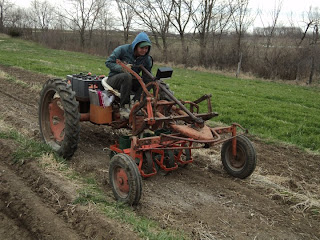


Farm beautification has proceeded with piles of brish being cut and fences cleared. We have also cleaned up and "rearranged" many outside storage areas to make them more attractive and useful. Like when you clean up your house for company, it is nice to be pushed to do the work you have always planned on doing.

"Heeling in" the onion transplants

Rebecca seeding beets

Broccoli and cabbage

Lettuce and kale

Uncovering the strawberries
Subscribe to:
Posts (Atom)

